‘Dual System of On-the-Job Training’
Bokaro Pvt. ITI with Bokaro Steel Plant as Industry Partner
1. Background
Technical Education and Vocational Training play a crucial role in supporting economic growth, social development,
and national wealth creation. They contribute significantly to poverty eradication by generating employment
opportunities for under-privileged and aspiring unemployed youth, thereby supporting sustainable national development.
India has over 15,000 Industrial Training Institutes (ITIs), of which approximately
85% are operated by the private sector and 15% are Government-run.
As per Skill Gap Reports, between 2013–2022, the incremental demand for skilled manpower was
estimated at 10 crore workers (around one crore per year), whereas all ITIs
together have only about 25 lakh seats per year.
While capacity remains a constraint, industries also report that the quality of training imparted to ITI trainees
is often below industry requirements. To bridge this gap between ITI learning outcomes and industry needs and to
make the workforce market-relevant, equitable, efficient and high-quality, the Ministry of Skill Development &
Entrepreneurship (MSDE) introduced the Dual System of Training (DST) scheme with effect from
August 2016.
After deliberations held on 6 June 2016 and subsequent discussions on 10 June 2016
at MSDE, New Delhi with State Directorates, Government/Private ITI Associations and Industry representatives, it was
decided to start DST from the August 2016 session in ITIs.
2. Objective of DST
The objective of the DST scheme is to enable industries and establishments to partner with Government and Private
ITIs for conducting training programmes under high-employability courses to fulfil skilled manpower requirements.
DST is an amalgamation of theoretical training imparted through ITIs and practical training imparted through the
Industry. It strengthens industry linkages and provides hands-on experience on the latest technologies.
Under DST, trainees who are awarded the National Trade Certificate (NTC) gain an edge over regular
ITI pass-outs in terms of employability and employment opportunities, as they become more industry-ready.
3. Expansion of the Scheme
The Dual System of Training, currently operational in 17 trades, will be expanded to all trades,
including service sector trades and trades in new and emerging sectors. All courses will be NSQF aligned.
4. Training Structure
- ITI Training: Theory portion, basic safety, tools, equipment and basic practical.
- Industry Training: On-the-job practical training in the industry.
5. Duration of Industrial Training
- Two-year courses: 09 months on-the-job training in Plant/Industry.
- One-year courses: 05 months on-the-job training in Plant/Industry.
6. Stipend during On-the-Job Training
-
Earlier, trainees were paid a stipend of 70% of minimum wages for semi-skilled workers
notified by the respective State Govt./UT (as payable to apprentices).
-
As per revised norms, the Industry may pay a suitable stipend through Direct Benefit Transfer (DBT)
as worker wages.
7. Seats and Shift Approval
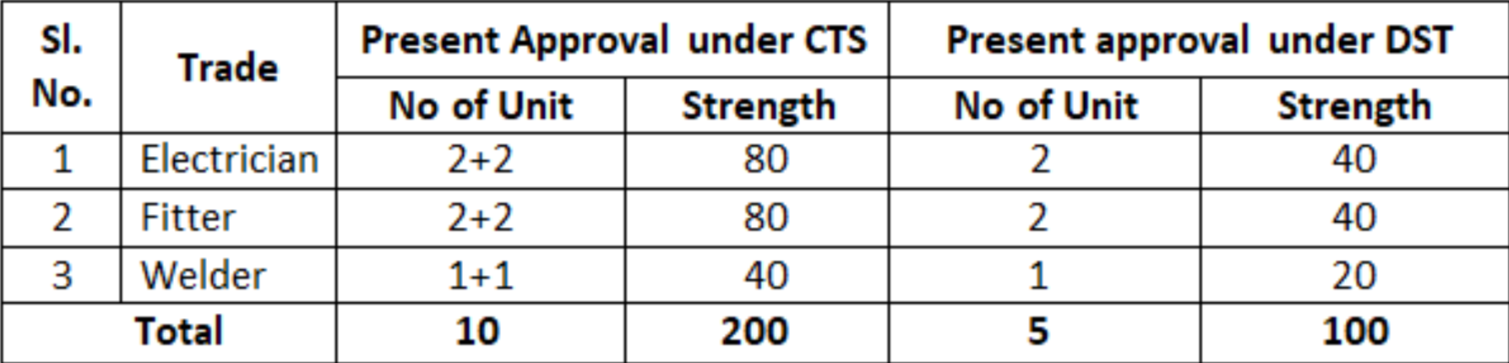
Bokaro Pvt. ITI has approval from the Member Secretary, NCVT for the 3rd shift. Accordingly,
the sanctioned strength stands enhanced as approved.
8. Multiple Training Locations (Industry)
The Industry Partner may train trainees at multiple locations to provide exposure to multiple skills.
For example, in the automotive sector, a trainee may be exposed to production/assembly, repair/service workshop,
and sales functions at a dealership.
9. Assessment and Certification
- Trade Theory and ITI workshop practical assessment will be conducted as per DGT/NCVT norms.
- Industrial Training (OJT) shall be assessed by the Industry Partner.
10. Admission and Examination
The admission and examination pattern for the scheme shall be the same as that of the
Craftsmen Training Scheme (CTS).
11. Certification
After successful completion of training, the National Trade Certificate (NTC) mentioning
Dual System Model shall be awarded to the trainees.
12. Role of Industry Partner
- Assign trainer(s) and follow the prescribed curriculum
- Prepare weekly training schedules and maintain training progress diary
- Provide training in domain skills and supervise trainees
-
ITI instructors shall accompany trainees to the Plant and provide required assistance as prescribed
for industry training activities
13. Benefits to Company
- Availability of skilled and trained manpower aligned with dynamically changing industry technologies
- Development of industry-specific skills, culture and knowledge in trainees
- Support in building skilled human resources for manufacturing units and entrepreneurship
-
Opportunity to showcase the project at State and National level, as BPITI & SAIL-BSL were the first
in the state to implement DST
14. NAPS Clarification
Earlier, DST trainees were registered under optional trades in the apprenticeship portal and were accounted
under total apprentices engaged by the company. However, DST has now been delinked from NAPS.
DST trainees will not be reimbursed under NAPS, and their examination will be conducted as per DST guidelines
since they obtain NTC (not NAC).
For earlier batches enrolled under DST where MoU was signed before issuance of revised guidelines
(i.e. enrolled in 2016, 2017, 2018), stipend reimbursement under NAPS shall continue as per the prevailing
guidelines applicable at that time.
15. Institutional Background
Bokaro Pvt. ITI (BPITI) was established under the aegis of CSR of the Company and is being managed smoothly
through Bokaro Ispat Educational Trust (BIET) for the last six years. Addition of
100 seats in the long run will ensure sustainability of the ITI.
16. Status of Trainees
As per the scheme, trainees shall remain on the rolls of the Institute even while undergoing industry training.
The Institute will be the main custodian. Hence, there shall be no claims such as medical, accommodation,
employment, etc. by the trainees from Bokaro Steel Plant.